Play free
  1. Melodic
  2. Guitar exercises

Guitar exercises that adapt to you

Training is Melodic’s technique gym: 14 drills, from picking the right string to bends, sweeps and tapping. Pick one and start playing. Melodic listens to every note, finds your level quickly and moves it after every rep, so the exercise is always just hard enough. Come back after a break and it warms you up first. And there’s no top level: the drills keep getting faster for as long as you keep getting better.

How a session works

Pick a technique. Start playing.

Open Training from the main menu and you’ll see every drill with your level on each one, and a suggestion for today: the drill you’ve left the longest, or one you haven’t tried. Point at a drill and it shows itself moving on a little highway at your level, with how to play it and every stage it goes through. Press Train, and after a count-in on the drumsticks the reps start coming.

A rep is a short exercise, five to ten seconds of music, with a breath before the next one. Reps are written fresh as you play, so you practise the move itself rather than memorising a few bars. They keep coming until you stop, and each one is judged the moment it ends.

  • Your coach on screen. As you start, and each time you reach a new stage, Mags says exactly what to do: which finger, which fret, which way to move.
  • A drummer to play with. Every drill has a groove of its own, from a ballad to funk, shuffle and metal, plus a metronome you can switch on with M.
  • Chord boxes when you need them. In the chord and strumming drills the next shape is drawn above the neck before it arrives.
  • Stop whenever you like. Every rep is saved as it ends, so closing the tab halfway loses nothing.
  • No guitar to hand? With note detection off the drill plays itself so you can watch and follow along. Nothing is scored and your level stays put.
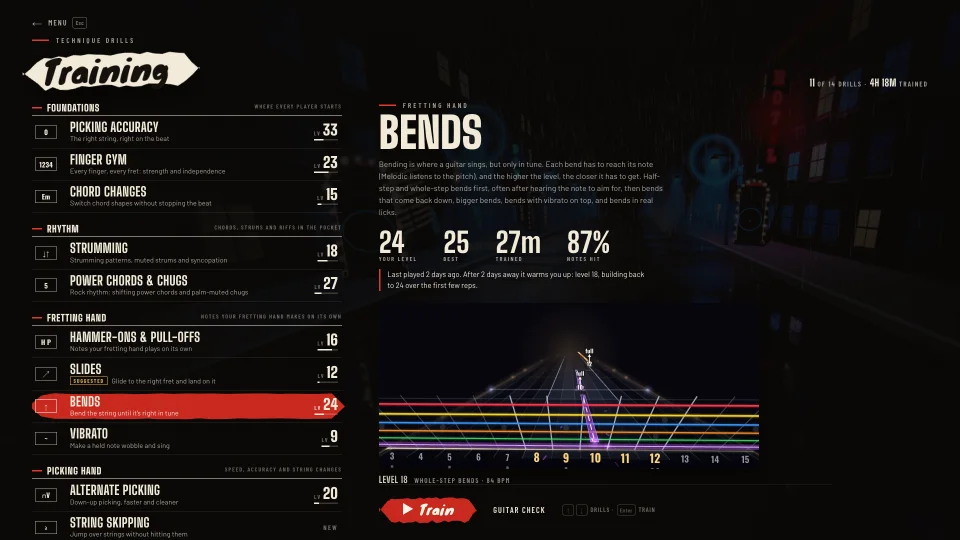
Melodic’s Training screen: every drill with your level on it, and the Bends drill picked
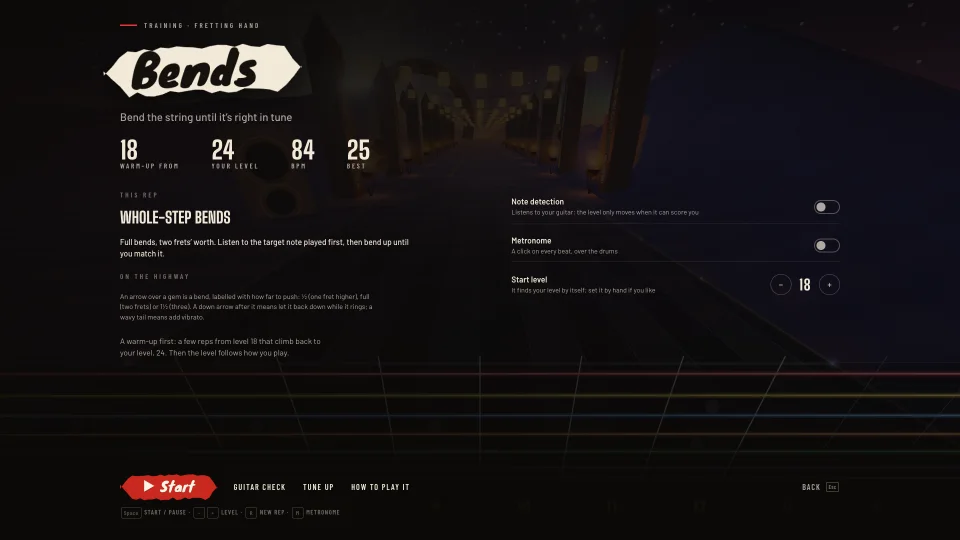
The start card of the Bends drill: a warm-up from level 18 back to level 24, and what to do in this rep

How the level moves

Always just hard enough

After every rep, the level moves by how well you played it. Hit 85% or more of the notes and the next rep is a little harder; hit fewer and it eases off. A clean rep moves it up a whole level, a near miss nudges it down a little, and a real struggle takes it down further. So the level settles where you hit about 85% of the notes, and follows you as you improve.

Why 85%? Practice teaches the most when it’s neither so easy that there’s nothing new, nor so hard that nothing sticks. Research on how people and machines learn puts that sweet spot at getting about 85% right (the “Eighty Five Percent Rule”, Wilson and colleagues, 2019).

  • It finds you fast. The first time you play a drill it starts at level 1 and jumps two to five levels at a time while every rep is clean, so a good player isn’t stuck on easy levels for long.
  • Every drill keeps its own level. Being great at chords says little about your bends, so no drill gets a head start from another.
  • Small steps. Within a stage each level is 4% faster than the one before. A new stage brings a new pattern and starts it slower again.
  • You’re in charge. Press − or + to set the level by hand, R for a fresh rep, Space to pause.
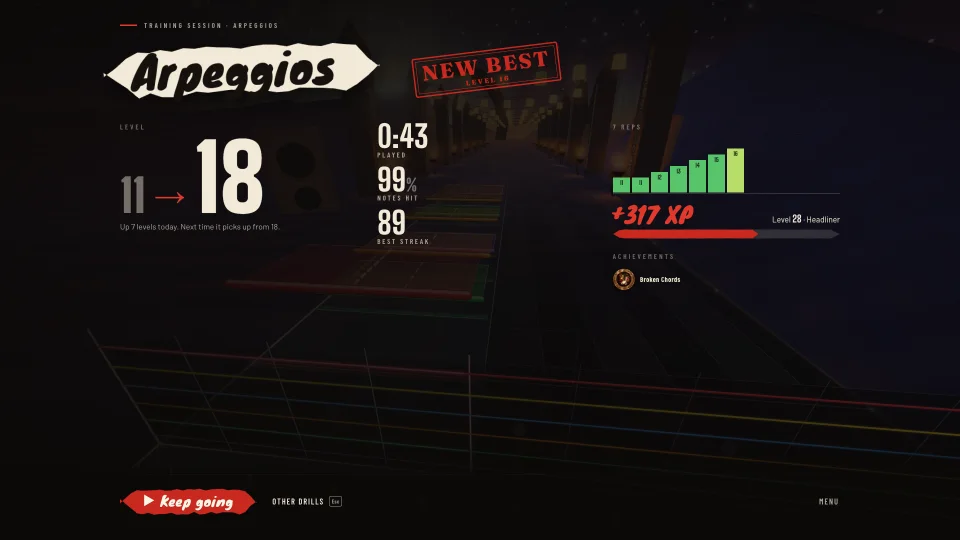
The end of a training session in Melodic: Arpeggios up from level 11 to 18, a new best, the reps as a chart, XP and a new badge

Warm-ups

Back after a break? Warm up first.

Skills are always a little rusty after time away; coaches call it the warm-up decrement. So when you come back to a drill, it doesn’t throw you straight in at your best. It starts a few levels lower and climbs back to your level over the first few reps. The longer you’ve been away, the lower it starts and the longer it takes. Here’s how it works out for a player at level 30:

The warm-up after time away, for a player at level 30
Time awayThe warm-up starts atBack to level 30 over
Under 15 minutesNo warm-up: straight back in at level 30—
Up to 4 hoursLevel 26 (13% down)3 reps
Up to 3 daysLevel 22 (27% down)6 reps
Up to 3 weeksLevel 20 (33% down)8 reps
Longer than thatLevel 18 (40% down)8 reps
  • Already warm? If you played another drill in the last half hour, the warm-up is half as deep and half as long.
  • Rustier than it thought? A warm-up rep you struggle with holds it back, or steps the warm-up down, and your level with it.
  • It never costs you. Warm-up reps count toward your time but not your level, and stopping during a warm-up keeps the level you had.
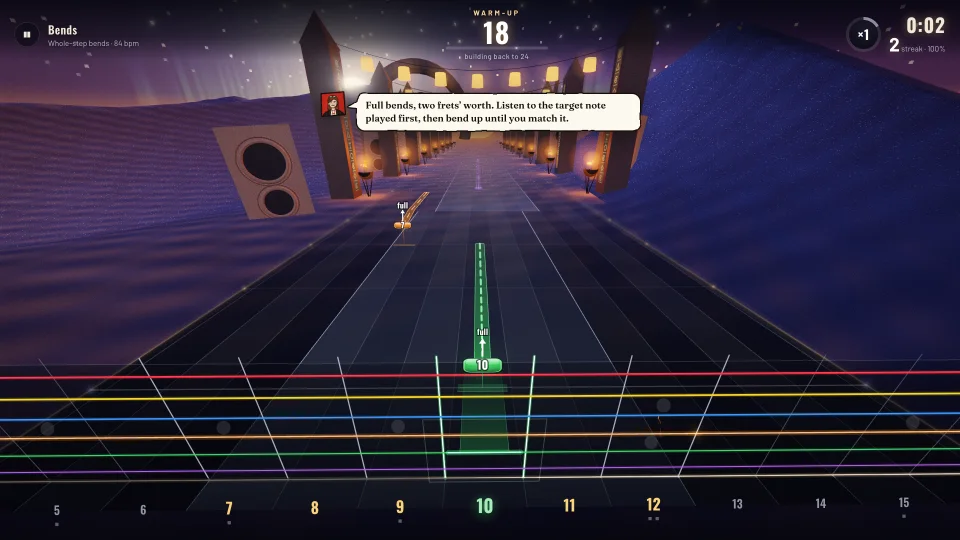
A warm-up in Melodic’s Bends drill: warm-up level 18, building back to 24, with the coach’s tip

No top level

For your first week and your tenth year

Every drill is a ladder of four to eight stages, each a new pattern that starts slow and speeds up level by level. Past the last stage there’s no top: the tempo keeps rising 3% a level, for as long as you can keep up. Beginners start on open strings at 60 beats a minute; advanced players can push sextuplets and sweeps as fast as their hands will go.

What it listens for

It hears the technique, not just the note

Melodic’s note detection listens to every pick, as it does in songs: which notes you played and exactly when. The drills listen for more than that, because a technique can be right or wrong even when the note is.

  • Bends have to get there. A bend only counts when the string reaches its pitch, and the higher the level, the closer it has to get. Fall short and you’ll see Bend higher.
  • Vibrato has to wobble. The pitch has to swing up and back while the note rings: a small wobble at first, a wider one later. Hold it still and you’ll see Wobble it.
  • No pick needed where there isn’t one. Hammer-ons, pull-offs and taps are heard as the notes they make, and a slide is judged by the note it lands on.
  • Chords note by note, so a strum that misses a string or catches the wrong one is caught.
  • You hear a miss as it happens, as a fumbled note, and your guitar plays through the drill’s own amp, from clean to crunch to distortion.
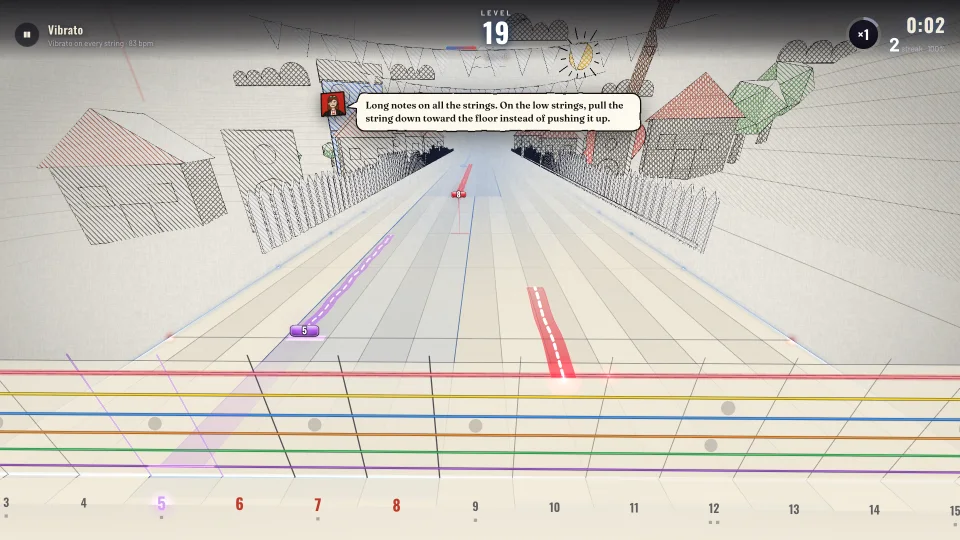
The Vibrato drill in Melodic: long notes with wavy tails on the Sketchbook stage

The drills

14 drills, every part of your playing

Each drill isolates one skill, the way a teacher would set an exercise. Here’s every one: what it builds, how it looks on the note highway, how to play it and the mistake to watch for. Open a drill’s ladder to see every stage and exactly what it asks of you. The pictures are from the game, each with Mags saying what to do.

Foundations

Where every player starts

0Picking Accuracy1234Finger GymEmChord Changes

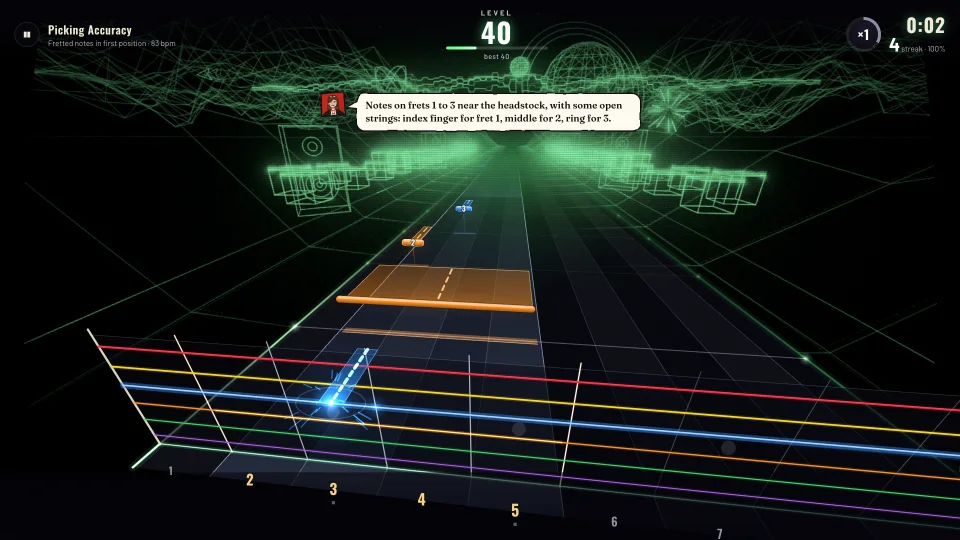
The Picking Accuracy drill in Melodic at level 40: fretted notes in first position
0 Level 40: fretted notes in first position at 83 BPM, with Mags saying what to do.

Foundations · 7 stages · levels 1–81, then no top

Picking Accuracy

The right string, right on the beat.

Finding the string a note is on and picking just that one, in time. It starts on open strings, adds your fretting hand in first position, then sends you all over the neck.

On the highway

Each note flies down the highway at the height of its string, in that string’s colour. A bar stretched across the lanes is an open string: press nothing. A gem with a number is a fretted note: the number is the fret.

How to play it

  1. Find the string first: a note’s colour and its height on the highway match its string on the neck below.
  2. For a numbered gem, press a fingertip just behind that fret; for a bar across the lanes, press nothing.
  3. Pick that one string with a short stroke from the wrist, just as the note reaches the strings, then get ready for the next.

Watch out A big, deep pick stroke is slow to come back. Keep it small, with the pick only just passing the string.

The ladder: 7 stages, from 60 BPM at level 1
  1. 1–10
    Open strings, one at a time 60–84 BPM

    Open strings only, two picks on each: low E, A, D, G, B, high E and back down. Press nothing; find the string and pick it on the beat.

  2. 11–20
    Open strings, any order 64–92 BPM

    Open strings in any order, one a beat. Read each bar’s colour and height to find its string before it arrives.

  3. 21–31
    Eighth notes on open strings 60–88 BPM

    Two neighbouring open strings, two notes a beat. Pick down on the beat and up in between, and leave the other strings alone.

  4. 32–42
    Fretted notes in first position 60–90 BPM

    Notes on frets 1 to 3 near the headstock, with some open strings: index finger for fret 1, middle for 2, ring for 3.

  5. 43–55
    First position in eighths 66–104 BPM

    The same first-position notes, two a beat. Keep your fingers hovering over frets 1 to 3 so they’re ready.

  6. 56–67
    Notes all over the neck 60–92 BPM

    Every bar your hand moves to a new spot on the neck: the lit lanes show where. Read the fret numbers and move before the notes arrive.

  7. 68–81
    All over the neck in eighths 66–110 BPM

    A new hand position every bar, two notes a beat. Look ahead to the lit lanes and move early.

  8. 82+
    No top level 3% faster every level

    Past the last stage it keeps getting faster, level after level, for as long as you can keep up.
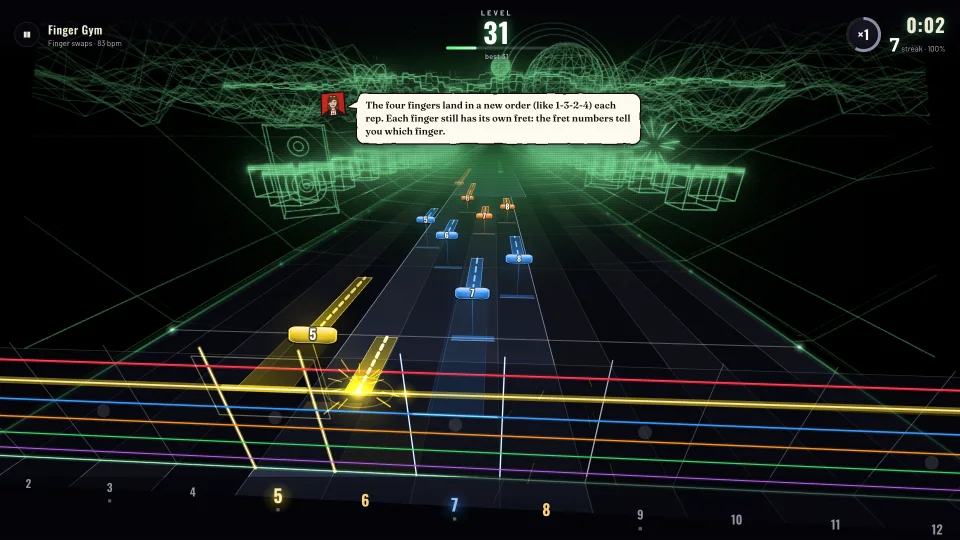
The Finger Gym drill in Melodic at level 31: finger swaps
1234 Level 31: finger swaps at 83 BPM, with Mags saying what to do.

Foundations · 6 stages · levels 1–70, then no top

Finger Gym

Every finger, every fret: strength and independence.

One finger for each fret, walking across the strings: the classic "spider". Later levels change the order your fingers land in, go diagonal, and stretch lower on the neck, where the frets are widest.

On the highway

Four notes on one string, one fret apart, then the same on the next string. The lit lanes show the four frets your hand covers; after each trip across the strings the block moves a fret along the neck.

How to play it

  1. Put your index finger on the first lit fret and give each of the next three frets its own finger: middle, ring, little.
  2. Play the four notes on one string, then the same four on the next string. Leave each finger down until the next one has landed.
  3. Pick every note (down, up, down, up) and press with the fingertips, just behind the fret wire.

Watch out Fingers that fly away from the strings waste time. Keep the ones you’re not using a few millimetres above the strings.

The ladder: 6 stages, from 60 BPM at level 1
  1. 1–10
    One finger a fret 60–84 BPM

    Index, middle, ring, little: one note each, one string at a time, low E up to high E. Coming back down, it’s little, ring, middle, index.

  2. 11–22
    Across the strings in eighths 60–92 BPM

    The same walk, two notes a beat. Keep the fingers you’ve used pressed down until you move to the next string.

  3. 23–33
    Finger swaps 60–90 BPM

    The four fingers land in a new order (like 1-3-2-4) each rep. Each finger still has its own fret: the fret numbers tell you which finger.

  4. 34–46
    Finger swaps in sixteenths 60–96 BPM

    The swapped orders, four notes a beat. Slow and even beats fast and messy.

  5. 47–58
    Diagonals 60–92 BPM

    One finger per string: index on the lowest string, middle one string up and one fret along, ring and little the same, then back down.

  6. 59–70
    Wide stretches 60–92 BPM

    Three notes a string, two frets apart: index, middle (or ring) and little finger. Stretch from the knuckles and keep your thumb low behind the neck.

  7. 71+
    No top level 3% faster every level

    Past the last stage it keeps getting faster, level after level, for as long as you can keep up.
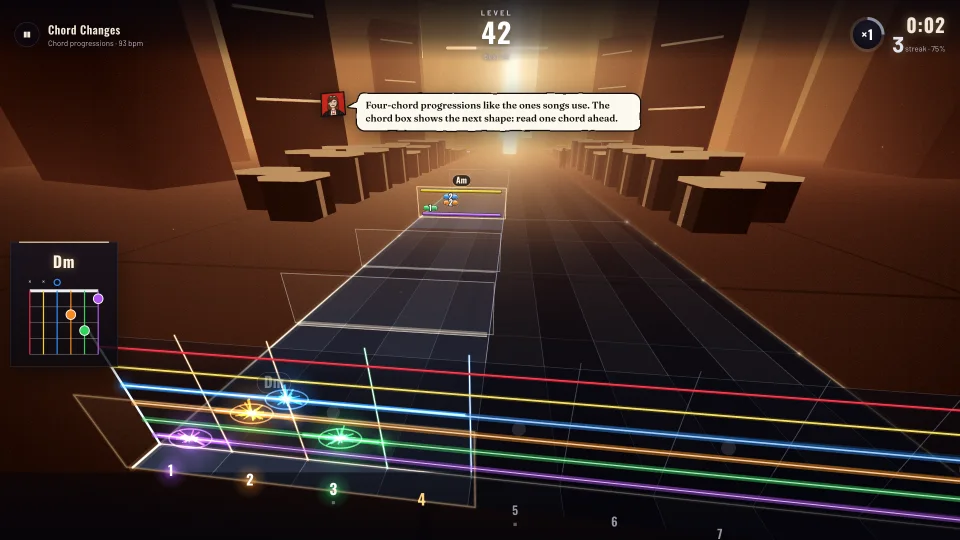
The Chord Changes drill in Melodic at level 42: chord progressions
Em Level 42: chord progressions at 93 BPM, with Mags saying what to do.

Foundations · 8 stages · levels 1–94, then no top

Chord Changes

Switch chord shapes without stopping the beat.

Moving your whole hand from one chord to the next in time, the skill behind every song. It starts with two easy chords and plenty of time to change, then adds chords, progressions, barre chords and less time between changes.

On the highway

A chord is a frame around several gems with its name on top; the shape is drawn in the chord box above the neck. Play every gem in the frame together, in one strum.

How to play it

  1. Before a chord arrives, look at its shape in the chord box above the neck and picture your fingers on it.
  2. Lift all your fingers off the old chord together and put them down on the new one together, not one at a time.
  3. Strum down through every string in the frame on the beat, even if the shape isn’t perfect yet.

Watch out Keep strumming in time even if you’re late getting to the chord. A finger that stays on the same fret in both chords can stay down.

The ladder: 8 stages, from 60 BPM at level 1
  1. 1–10
    Two chords, two strums each 60–84 BPM

    Two chords back and forth, two slow strums each. Change on the empty beat between them.

  2. 11–21
    Four strums a chord 60–90 BPM

    A strum on every beat and a new chord every bar. Start moving to the next chord straight after the fourth strum.

  3. 22–32
    Two chords a bar 60–90 BPM

    A new chord every two beats: less time to change, so move the moment the second strum is done.

  4. 33–44
    Chord progressions 66–100 BPM

    Four-chord progressions like the ones songs use. The chord box shows the next shape: read one chord ahead.

  5. 45–55
    Barre chords 60–88 BPM

    Barre chords: your index finger lies flat across every string (the frame has no open strings) and the other fingers make the shape. Squeeze with your thumb behind the neck.

  6. 56–67
    Barre progressions 66–100 BPM

    Progressions of barre chords, a strum every beat. To change, loosen the barre and slide it to the new fret rather than lifting it off.

  7. 68–80
    A chord every two beats 60–96 BPM

    Open and barre chords mixed, a new one every two beats.

  8. 81–94
    A chord every beat 60–100 BPM

    A new chord on every beat. Plan the next shape while you strum this one.

  9. 95+
    No top level 3% faster every level

    Past the last stage it keeps getting faster, level after level, for as long as you can keep up.
Rhythm

Chords, strums and riffs in the pocket

↓↑Strumming5Power Chords & Chugs

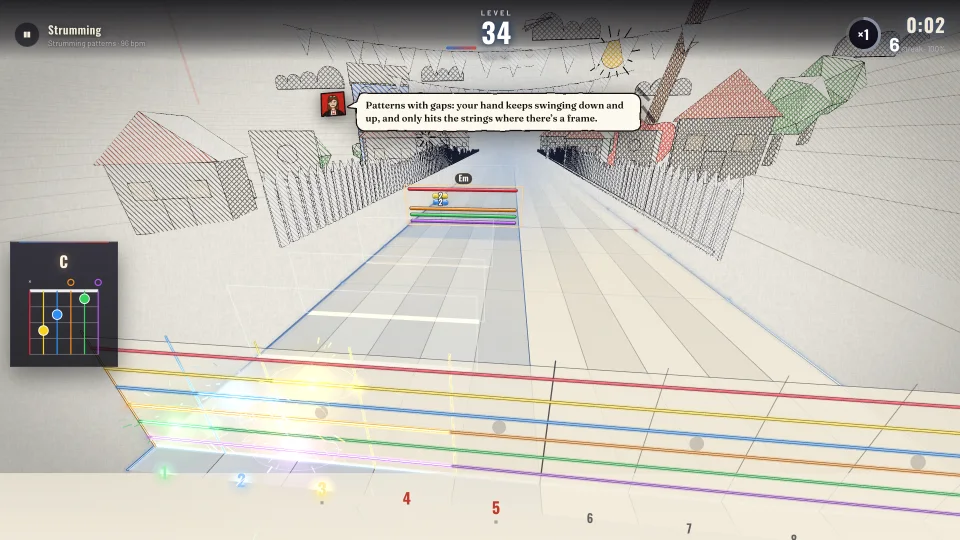
The Strumming drill in Melodic at level 34: strumming patterns
↓↑ Level 34: strumming patterns at 96 BPM, with Mags saying what to do.

Rhythm · 6 stages · levels 1–74, then no top

Strumming

Strumming patterns, muted strums and syncopation.

Keeping your strumming hand moving like a pendulum, down on the beat and up in between, and only touching the strings when the pattern says so. From steady downstrokes to eighth-note patterns, funky muted strums and sixteenth-note grooves with pushes.

On the highway

Each strum is a chord frame: play every string in it. A grey frame with crosses is a muted strum, a scratchy “chk” with no notes. Where there’s a gap, your hand swings past without touching the strings.

How to play it

  1. Keep your arm swinging all the time, like a pendulum: down on the beats, up in between.
  2. Only let the pick hit the strings where there’s a frame; on a gap the hand keeps moving but misses the strings.
  3. For a muted strum, relax your fretting fingers so they touch the strings without pressing them down, then strum.

Watch out Stopping your hand for a gap throws the rhythm off. The swing never stops; it just misses the strings.

The ladder: 6 stages, from 60 BPM at level 1
  1. 1–12
    Down on every beat 60–92 BPM

    One downstroke on each beat, on an E minor chord (Em). Keep every strum the same strength and right on the beat.

  2. 13–23
    Down and up in eighths 60–90 BPM

    Down on the beat, up in between: two strums a beat, with a new chord every bar.

  3. 24–36
    Strumming patterns 66–104 BPM

    Patterns with gaps: your hand keeps swinging down and up, and only hits the strings where there’s a frame.

  4. 37–49
    Muted strums 70–110 BPM

    The grey frames are muted strums: loosen your fretting hand so the strings go dead for that strum, then press the chord again for the next.

  5. 50–61
    Sixteenth-note patterns 60–92 BPM

    Four swings a beat now: down-up-down-up. Keep the swing small and loose, and hit the strings only where the frames are.

  6. 62–74
    Pushes and syncopation 66–104 BPM

    Some chords arrive just before the beat (a push): the strum on the last half-beat of a bar already belongs to the next chord.

  7. 75+
    No top level 3% faster every level

    Past the last stage it keeps getting faster, level after level, for as long as you can keep up.
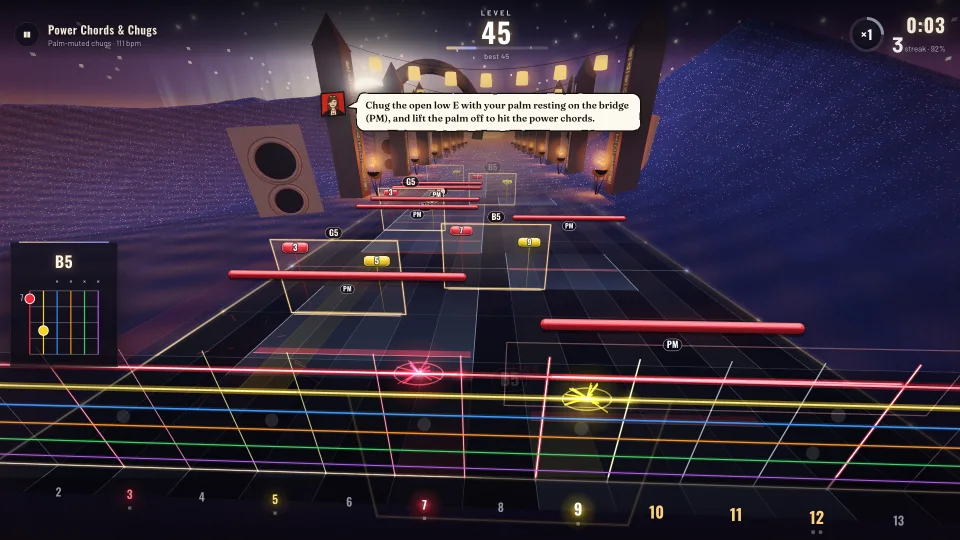
The Power Chords & Chugs drill in Melodic at level 45: palm-muted chugs
5 Level 45: palm-muted chugs at 111 BPM, with Mags saying what to do.

Rhythm · 6 stages · levels 1–71, then no top

Power Chords & Chugs

Rock rhythm: shifting power chords and palm-muted chugs.

The engine room of rock and metal. One-finger power chords first, then moving the shape up and down the neck, riffs across two strings, and tight palm-muted chugs and gallops between the chords.

On the highway

A power chord is a small frame of two gems on neighbouring strings, named like E5 or G5. PM under a note means palm-muted: a short, chunky chug.

How to play it

  1. Index finger on the lower string’s fret, ring finger two frets up on the next string: that shape never changes.
  2. Pick both strings in one downstroke, with your fretting fingers lying lightly on the other strings to keep them quiet.
  3. For PM notes, rest the edge of your picking hand on the strings right by the bridge and pick through it; lift it off for the chords.

Watch out Keep the shape locked as you move it along the neck: loosen your grip to move, press again to play.

The ladder: 6 stages, from 60 BPM at level 1
  1. 1–11
    One-finger power chords 60–90 BPM

    E5, A5 and D5: the lower string open and one finger on fret 2 of the next string up. Pick both strings together.

  2. 12–23
    Moving the shape 66–100 BPM

    The two-finger shape slides up and down the low E string. The fret on the lower gem is where your index finger goes.

  3. 24–36
    Riffs across two strings 70–110 BPM

    Power chords with their lower note on the low E or on the A string, in a riff. Move the whole shape across a string without changing it.

  4. 37–47
    Palm-muted chugs 80–120 BPM

    Chug the open low E with your palm resting on the bridge (PM), and lift the palm off to hit the power chords.

  5. 48–58
    Gallops 80–120 BPM

    Gallops on the muted low E: one chug, then two quick ones (da-da-dum), with a power chord to end each bar.

  6. 59–71
    Sixteenth-note riffs 80–130 BPM

    Chugs four to a beat, with power chord stabs. Small, fast down-up picking with your palm on the bridge.

  7. 72+
    No top level 3% faster every level

    Past the last stage it keeps getting faster, level after level, for as long as you can keep up.
Fretting hand

Notes your fretting hand makes on its own

H PHammer-ons & Pull-offs↗Slides↑Bends~Vibrato

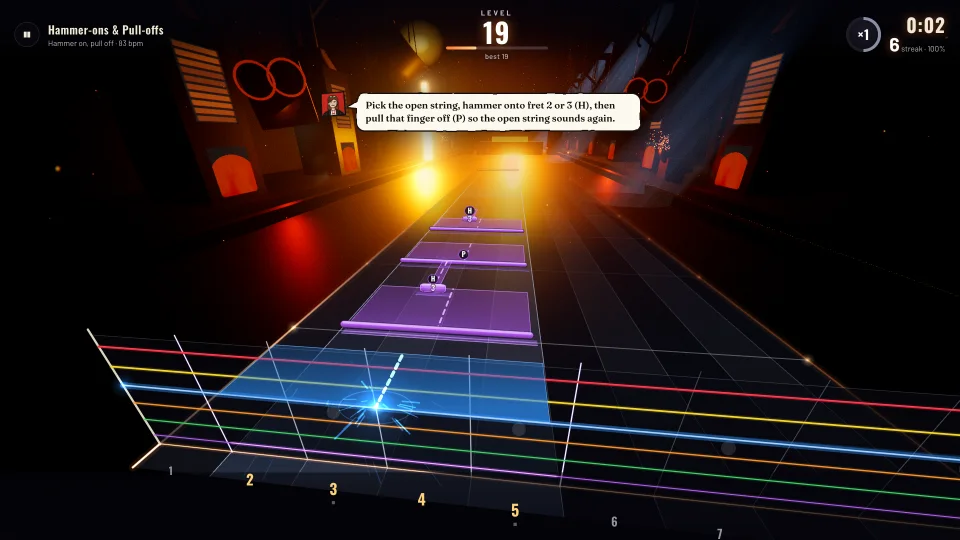
The Hammer-ons & Pull-offs drill in Melodic at level 19: hammer on, pull off
H P Level 19: hammer on, pull off at 83 BPM, with Mags saying what to do.

Fretting hand · 7 stages · levels 1–84, then no top

Hammer-ons & Pull-offs

Notes your fretting hand plays on its own.

Legato: one pick, several notes. Hammer-ons and pull-offs from open strings first, then between fretted notes with every pair of fingers (the weak ring and little fingers last), trills, three-note rolls and whole scale runs.

On the highway

H over a gem is a hammer-on and P a pull-off: those notes aren’t picked. Only the note before them is.

How to play it

  1. Pick the first note only. The H and P notes are played by your fretting hand.
  2. For H, bring a finger down hard and fast just behind the new fret: the impact makes the note sound.
  3. For P, pull the finger off sideways (toward the floor) so it flicks the string as it leaves, and the lower note, fretted or open, sounds.

Watch out Every note should be as loud as the picked one. A lazy hammer, or a finger lifted straight up, fades away.

The ladder: 7 stages, from 60 BPM at level 1
  1. 1–10
    Hammer-ons from open strings 60–84 BPM

    Pick the open string, then hammer a finger onto fret 2 of the same string (H). Two notes, one pick.

  2. 11–21
    Hammer on, pull off 60–90 BPM

    Pick the open string, hammer onto fret 2 or 3 (H), then pull that finger off (P) so the open string sounds again.

  3. 22–32
    Fretted hammer-ons 60–90 BPM

    Your index holds the lower fret: pick it, then hammer another finger onto the higher fret (H). A new string and pair of fingers each bar.

  4. 33–43
    Fretted pull-offs 60–90 BPM

    Put both fingers down first. Pick the higher fret, then pull that finger off (P) so the index finger’s note sounds.

  5. 44–56
    Trills 60–96 BPM

    Pick once, then hammer and pull between the two frets as fast as the notes come (H, P, H, P). The index stays down the whole time.

  6. 57–70
    Three-note legato 60–100 BPM

    Three notes on a string for each pick: going up, pick then hammer twice; coming down, pick then pull off twice.

  7. 71–84
    Legato runs 60–100 BPM

    A scale with three notes on each string: pick only the first note on each string, and hammer (going up) or pull off (coming down) the other two.

  8. 85+
    No top level 3% faster every level

    Past the last stage it keeps getting faster, level after level, for as long as you can keep up.
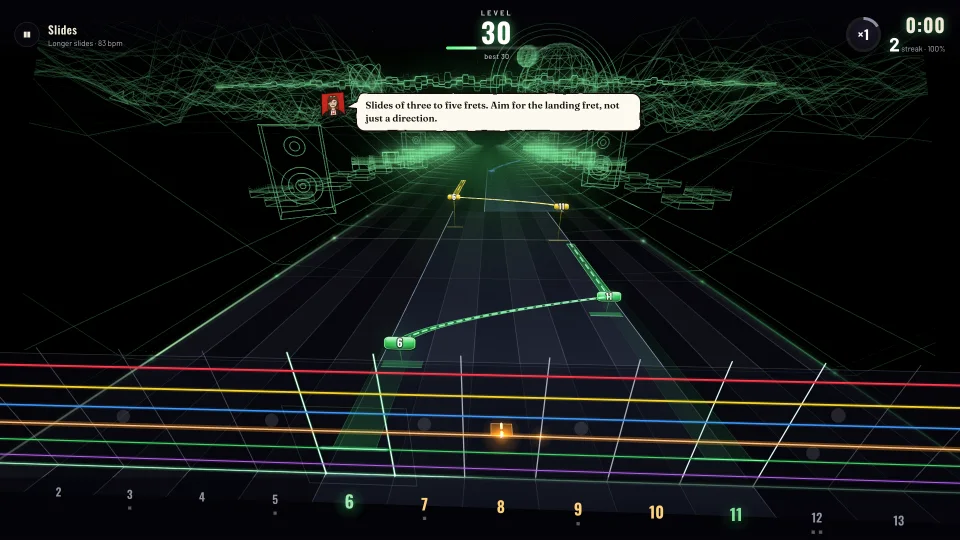
The Slides drill in Melodic at level 30: longer slides
↗ Level 30: longer slides at 83 BPM, with Mags saying what to do.

Fretting hand · 5 stages · levels 1–57, then no top

Slides

Glide to the right fret and land on it.

Slides move your hand around the neck without a gap in the sound. You pick once and glide to the target fret: two-fret slides first, then longer ones in both directions, slides that shift your hand into a new position, and quick slides in a run.

On the highway

A slide is a gem whose tail bends across the lanes to the fret it lands on, and that landing note comes as a gem of its own. Only the first gem is picked; the second one is where your finger stops.

How to play it

  1. Pick the first note and keep pressing the string down.
  2. Glide the same finger along the string, following the tail, and stop just behind the fret of the landing gem.
  3. Don’t pick again when you land: the note keeps ringing all the way there, and you hold it.

Watch out Easing off the pressure halfway kills the note. Keep the finger pressed down the whole way.

The ladder: 5 stages, from 60 BPM at level 1
  1. 1–10
    Slide up two frets 60–84 BPM

    Pick, then slide the same finger two frets up the string and hold the note you land on.

  2. 11–21
    Up and back down 60–90 BPM

    Slides of two or three frets, up or down the neck. Follow the tail to the fret it points to.

  3. 22–32
    Longer slides 60–90 BPM

    Slides of three to five frets. Aim for the landing fret, not just a direction.

  4. 33–44
    Slide into position 66–100 BPM

    Slide to move your whole hand to a new spot, then play two notes on the next string from where you landed.

  5. 45–57
    Quick slides 70–110 BPM

    A short slide on every beat, landing half a beat later. Quick and snappy, but keep the pressure on.

  6. 58+
    No top level 3% faster every level

    Past the last stage it keeps getting faster, level after level, for as long as you can keep up.
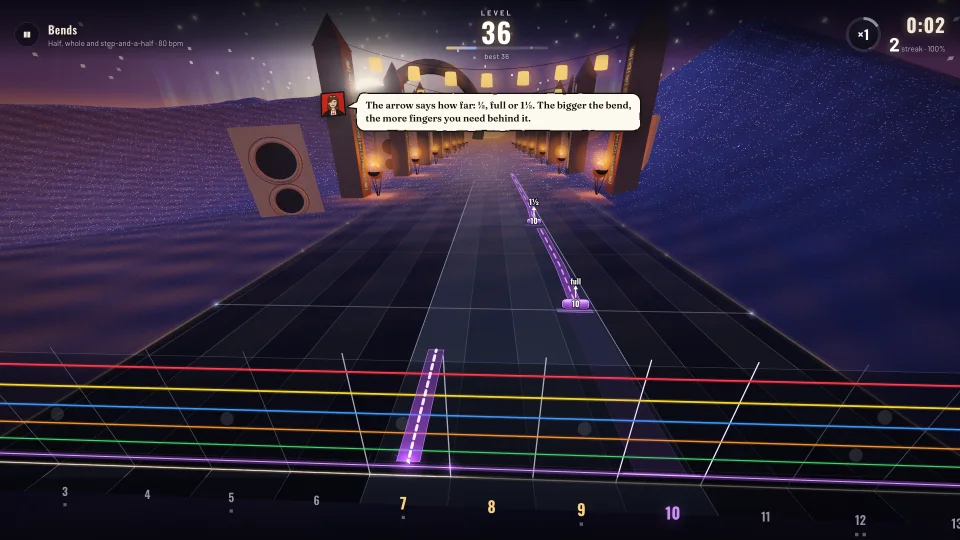
The Bends drill in Melodic at level 36: half, whole and step-and-a-half
↑ Level 36: half, whole and step-and-a-half at 80 BPM, with Mags saying what to do.

Fretting hand · 7 stages · levels 1–73, then no top

Bends

Bend the string until it’s right in tune.

Bending is where a guitar sings, but only in tune. Each bend has to reach its note (Melodic listens to the pitch), and the higher the level, the closer it has to get. Half-step and whole-step bends first, often after hearing the note to aim for, then bends that come back down, bigger bends, bends with vibrato on top, and bends in real licks.

On the highway

An arrow over a gem is a bend, labelled with how far to push: ½ (one fret higher), full (two frets) or 1½ (three). A down arrow after it means let it back down while it rings; a wavy tail means add vibrato.

How to play it

  1. Fret the note with your ring finger, with your middle and index fingers on the same string behind it to help push.
  2. Pick, then push the string across the neck (toward the ceiling on the G, B and high E strings), turning from the wrist rather than pushing with the fingers.
  3. Listen and stop when the note sounds like its target (full = the note two frets higher), then hold it there until the tail ends.

Watch out Most bends fall short: push until it sounds right, not until it feels far enough. Melodic only counts a bend that gets there.

The ladder: 7 stages, from 60 BPM at level 1
  1. 1–8
    Half-step bends 60–80 BPM

    Push the note up by one fret’s worth. Early on, the note you’re aiming for is played first, fretted normally, so you know where to stop.

  2. 9–18
    Whole-step bends 60–84 BPM

    Full bends, two frets’ worth. Listen to the target note played first, then bend up until you match it.

  3. 19–28
    Bend and release 60–84 BPM

    Bend up a whole step, hold it, then let the string back down slowly without picking again. Then pick the unbent note once more.

  4. 29–39
    Half, whole and step-and-a-half 60–90 BPM

    The arrow says how far: ½, full or 1½. The bigger the bend, the more fingers you need behind it.

  5. 40–49
    Bend and vibrato 60–84 BPM

    Bend up a whole step, then wobble it at the top: let the bend down a little and push it back up, again and again, until the wavy tail ends.

  6. 50–61
    Bends in licks 66–100 BPM

    Real licks from the pentatonic box: the bent notes have to reach their pitch in the flow of the phrase.

  7. 62–73
    Quick bends 76–116 BPM

    A fast bend on every beat, then a picked note. Push up quickly and land in tune.

  8. 74+
    No top level 3% faster every level

    Past the last stage it keeps getting faster, level after level, for as long as you can keep up.
The Vibrato drill in Melodic at level 19: vibrato on every string
~ Level 19: vibrato on every string at 83 BPM, with Mags saying what to do.

Fretting hand · 5 stages · levels 1–56, then no top

Vibrato

Make a held note wobble and sing.

Vibrato is the wobble that makes a long note sing instead of just sitting there. Melodic listens for it: the pitch has to swing up and back while the note rings. Slow wobbles on long notes first, then every string, shorter notes, vibrato on top of a bend, and vibrato in licks.

On the highway

A wavy tail on a gem means vibrato: keep the note ringing and wobble it for as long as the tail lasts.

How to play it

  1. Fret the note (the ring finger is easiest, with the other fingers on the string behind it) and pick it.
  2. Push the string a little way across the neck and let it back, again and again, like a small bend and release. Move from the wrist, not the fingertip.
  3. Keep it going until the tail ends: slow and even at first, then quicker as the notes get shorter.

Watch out The pitch should rise and come back to the note, not creep sharp and stay there. An even wobble sounds best.

The ladder: 5 stages, from 60 BPM at level 1
  1. 1–10
    Slow vibrato on long notes 60–84 BPM

    One long note every two beats. Pick it, then wobble it slowly (push up a little, let back down) until its wavy tail ends.

  2. 11–21
    Vibrato on every string 60–90 BPM

    Long notes on all the strings. On the low strings, pull the string down toward the floor instead of pushing it up.

  3. 22–34
    Shorter notes 60–96 BPM

    A note with vibrato on every beat. Start the wobble straight after the pick: there’s less time, so it has to be quicker.

  4. 35–44
    Bend and vibrato 60–84 BPM

    Bend up a whole step, then add vibrato at the top: let it down a little and push it back up, staying in tune.

  5. 45–56
    Vibrato in licks 66–100 BPM

    Pentatonic licks where the long notes (and the bends) end with vibrato, as in a solo.

  6. 57+
    No top level 3% faster every level

    Past the last stage it keeps getting faster, level after level, for as long as you can keep up.

Picking hand

Speed, accuracy and string changes

⊓VAlternate Picking⤸String Skipping

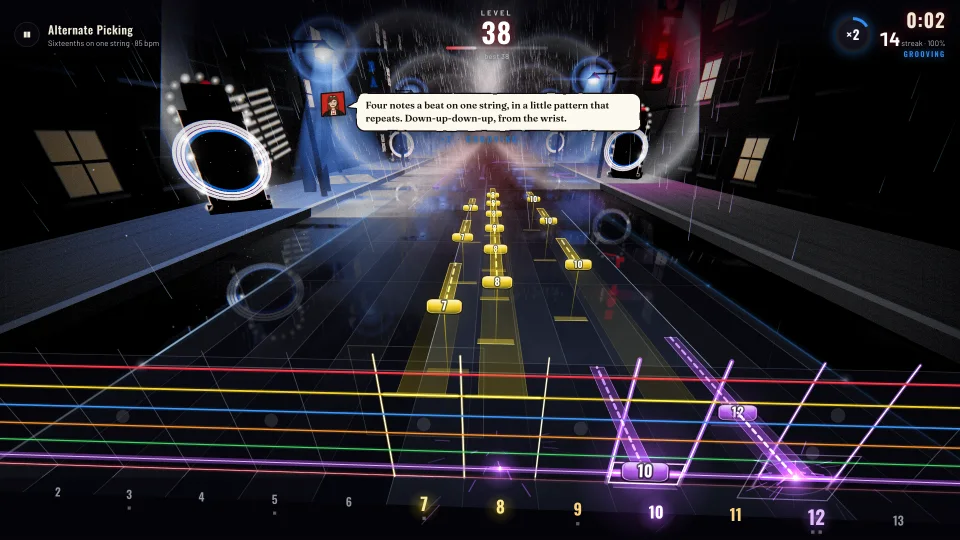
The Alternate Picking drill in Melodic at level 38: sixteenths on one string
⊓V Level 38: sixteenths on one string at 85 BPM, with Mags saying what to do.

Picking hand · 6 stages · levels 1–82, then no top

Alternate Picking

Down-up picking, faster and cleaner.

Strict down-up picking is how fast single-note lines are played. Eighths on one string first, then crossing strings, sixteenths, scale runs, speed bursts (short runs at your top speed between slower notes) and sextuplets.

On the highway

Plain gems one after another, often several on the same string. Every note is picked: down, up, down, up.

How to play it

  1. Down on the beat, up in between: never two picks the same way in a row, even when you change string.
  2. Keep the movement small, from the wrist, with the tip of the pick only just passing the string.
  3. Relax your grip: hold the pick just firmly enough not to drop it.

Watch out Speed comes from staying relaxed. If your arm tenses up, the level is too high today: it will ease off.

The ladder: 6 stages, from 60 BPM at level 1
  1. 1–14
    Eighths on one string 60–100 BPM

    Two notes a beat on one string, a new string every bar. Down, up, down, up, strictly.

  2. 15–28
    Crossing strings 60–100 BPM

    Up and down the pentatonic box, two notes on each string: the pick has to hop to the next string at just the right moment.

  3. 29–41
    Sixteenths on one string 60–96 BPM

    Four notes a beat on one string, in a little pattern that repeats. Down-up-down-up, from the wrist.

  4. 42–55
    Scale runs in sixteenths 60–100 BPM

    A scale with three notes on each string, four notes a beat: up, then back down, strictly alternating.

  5. 56–68
    Speed bursts 70–110 BPM

    Steady eighths, then a burst of four quick notes on one string near the end of each bar. Stay loose through the burst.

  6. 69–82
    Sextuplets 60–100 BPM

    Six notes a beat through the three-notes-a-string scale. Lean on the first note of each six to keep your place.

  7. 83+
    No top level 3% faster every level

    Past the last stage it keeps getting faster, level after level, for as long as you can keep up.
The String Skipping drill in Melodic at level 22: octaves
⤸ Level 22: octaves at 85 BPM, with Mags saying what to do.

Picking hand · 5 stages · levels 1–65, then no top

String Skipping

Jump over strings without hitting them.

Landing on a string that isn’t next to the last one. Open strings two apart first, then octaves, fretted patterns, wider skips over two strings and arpeggios spread across the neck.

On the highway

Notes that jump over a string (or two). Watch the colours: the string in between isn’t played.

How to play it

  1. Aim the pick at the target string and move in a small arc over the strings in between.
  2. Keep the skipped strings quiet: your fretting fingers lie lightly across them.
  3. Look ahead: start the jump before the note arrives, not when it does.

Watch out Hitting the string in between is the usual slip. Make the arc over it a little bigger, then smaller as it gets easy.

The ladder: 5 stages, from 60 BPM at level 1
  1. 1–12
    Skip one string 60–92 BPM

    Two strings with one between them (like low E and D), a note a beat, back and forth. Leave the middle string alone.

  2. 13–25
    Octaves 60–96 BPM

    A note on the low E or A string, then the same note two strings up and two frets higher. Let your index finger rest on the string between to keep it quiet.

  3. 26–38
    Skipping patterns 66–104 BPM

    Two strings with one between, in one hand position, bouncing between them in eighths.

  4. 39–52
    Wider skips 60–100 BPM

    Now two strings in between: bigger jumps, still with a small arc.

  5. 53–65
    Skipping arpeggios 60–96 BPM

    Chord notes spread over three strings two apart: low, middle, high, middle, four notes a beat.

  6. 66+
    No top level 3% faster every level

    Past the last stage it keeps getting faster, level after level, for as long as you can keep up.
Lead

Scales, arpeggios and flash

♪Scale Runs⋰ArpeggiosTTapping

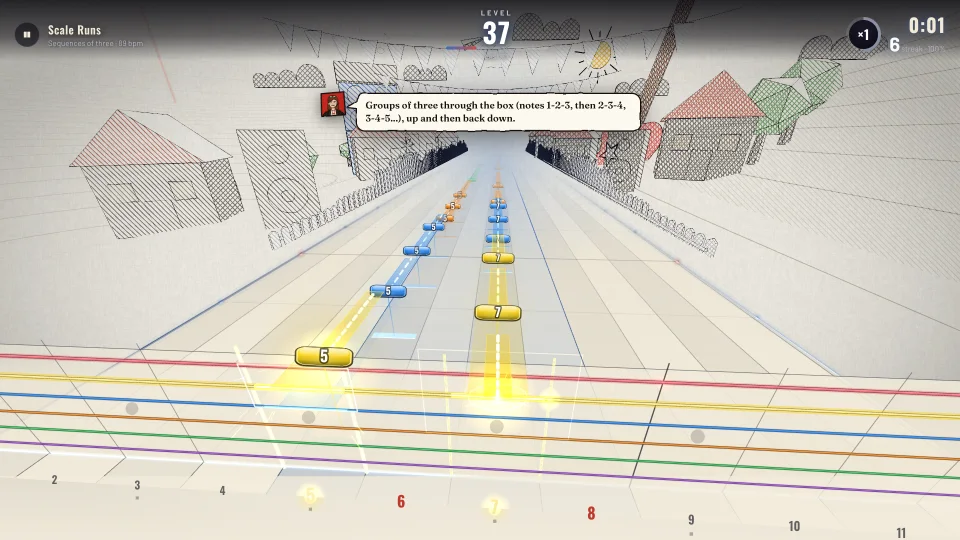
The Scale Runs drill in Melodic at level 37: sequences of three
♪ Level 37: sequences of three at 89 BPM, with Mags saying what to do.

Lead · 6 stages · levels 1–82, then no top

Scale Runs

The pentatonic box and beyond, up to speed.

The shapes every solo is built from. The minor pentatonic box up and down, then in eighths, in sequences of three and four, the three-notes-per-string minor scale, and runs that travel across the neck.

On the highway

Runs of notes through a scale shape. The lit lanes show the box your hand stays in.

How to play it

  1. One finger per fret in the box: index on the lowest lit fret, little finger (or ring) on the highest.
  2. Alternate your picking all the way through: down, up, down, up.
  3. Learn the shape as you go: say the pattern to yourself as you play it.

Watch out Uneven notes are the tell of rushing. Every note should be the same length and loudness.

The ladder: 6 stages, from 60 BPM at level 1
  1. 1–12
    Pentatonic box, up and down 60–92 BPM

    The minor pentatonic box, two notes on each string: up from the low E to the high E and back down, a note a beat.

  2. 13–26
    Pentatonic in eighths 60–100 BPM

    The same box, two notes a beat. When a run finishes, the box moves to a new key.

  3. 27–40
    Sequences of three 60–100 BPM

    Groups of three through the box (notes 1-2-3, then 2-3-4, 3-4-5...), up and then back down.

  4. 41–54
    Sequences of four 60–100 BPM

    Groups of four through the box, four notes a beat.

  5. 55–68
    Three notes a string 60–100 BPM

    The minor scale with three notes on every string, up and down in sixteenths. Your hand shifts up a fret or so as you climb.

  6. 69–82
    Across the neck 60–100 BPM

    Two octaves of pentatonic that travel up the neck: shift your hand where the notes move to a new position.

  7. 83+
    No top level 3% faster every level

    Past the last stage it keeps getting faster, level after level, for as long as you can keep up.
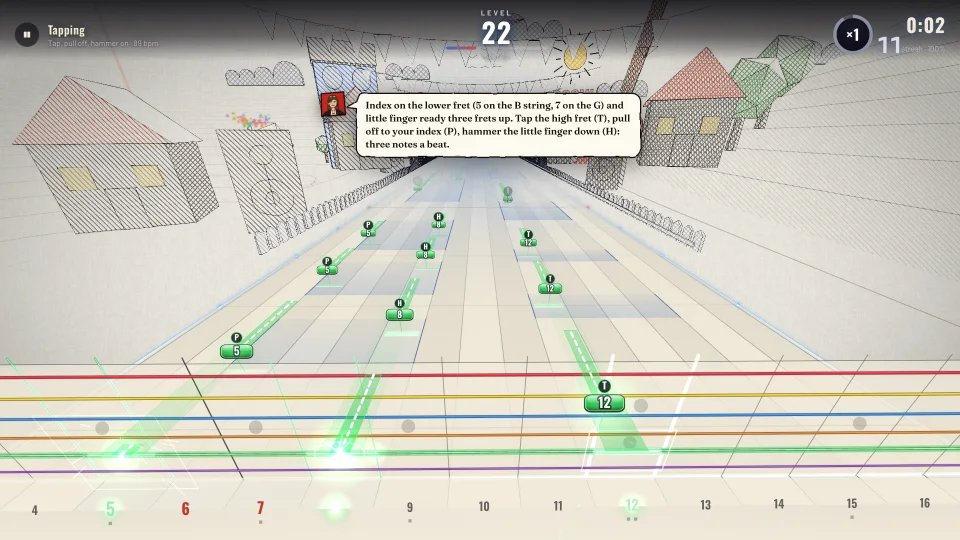
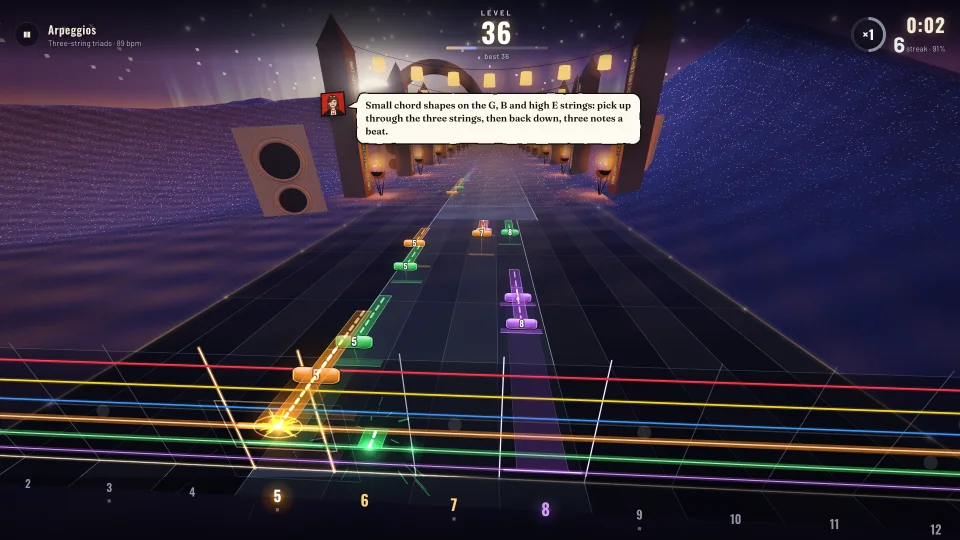
The Arpeggios drill in Melodic at level 36: three-string triads
⋰ Level 36: three-string triads at 89 BPM, with Mags saying what to do.

Lead · 4 stages · levels 1–52, then no top

Arpeggios

Chords one note at a time, up to sweeps.

Picking a chord’s notes one after another. Open chords picked string by string first (the sound of countless ballads), then picking patterns, three-string triads and five-string sweeps.

On the highway

Single gems that climb and fall across the strings. They’re a chord shape played one string at a time.

How to play it

  1. Hold the whole chord shape down before it starts, then pick its strings one at a time in the order the gems come.
  2. For open chords, let the notes ring into each other.
  3. For sweeps, push the pick through the strings in one smooth motion, one note per string, instead of separate strokes.

Watch out In a fast sweep, two notes ringing together smear: ease each finger off slightly once its note has sounded.

The ladder: 4 stages, from 60 BPM at level 1
  1. 1–12
    Open chords, string by string 60–92 BPM

    Hold an open chord and pick from its lowest string up to the top and back down, one string per note. A new chord every bar.

  2. 13–25
    Picking patterns 66–104 BPM

    The chord’s lowest note, then a pattern on the higher strings, like fingerpicking with a pick. A new chord every bar.

  3. 26–39
    Three-string triads 60–100 BPM

    Small chord shapes on the G, B and high E strings: pick up through the three strings, then back down, three notes a beat.

  4. 40–52
    Five-string sweeps 60–96 BPM

    Chord shapes from the A string up to the high E and back: one sweeping motion of the pick in each direction.

  5. 53+
    No top level 3% faster every level

    Past the last stage it keeps getting faster, level after level, for as long as you can keep up.
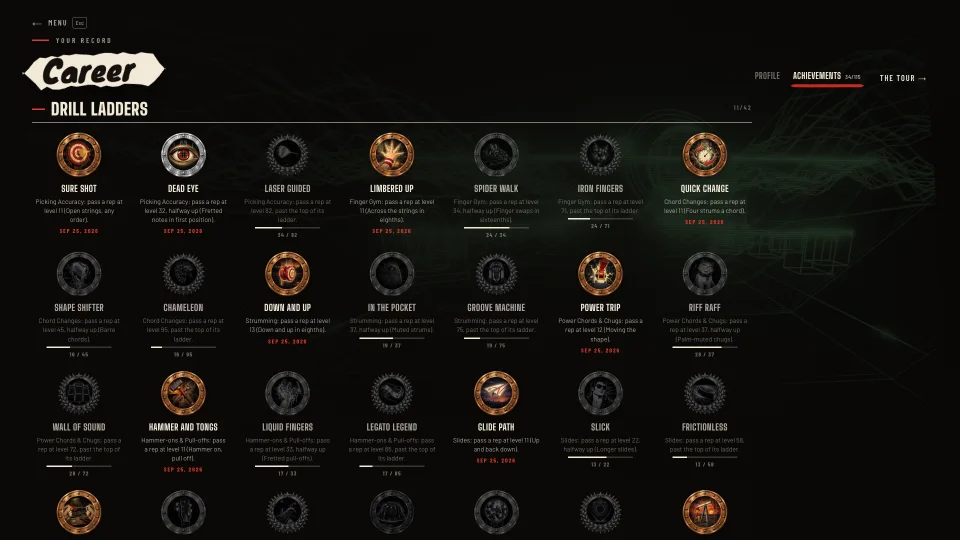
The Tapping drill in Melodic at level 22: tap, pull off, hammer on
T Level 22: tap, pull off, hammer on at 89 BPM, with Mags saying what to do.

Lead · 4 stages · levels 1–53, then no top

Tapping

Your picking hand on the fretboard.

Tapping plays a note with a finger of your picking hand, for runs no fretting hand can reach. Tap and pull off first, then the classic tap, pull-off, hammer-on triplet, taps that move with the chords, and patterns across two strings.

On the highway

T over a gem: tap that fret with a finger of your picking hand. P on the next gem: that note is already being held by your fretting hand, and pulling the tapping finger off makes it sound. H: hammer a fretting-hand finger down. Nothing slides.

How to play it

  1. Before you start, put your fretting hand’s index finger on the lowest fret of the pattern (the P note’s fret) and keep it pressed there the whole time.
  2. Tap (T): hammer the higher fret hard with the middle or index finger of your picking hand, just behind the fret wire.
  3. Pull-off (P): flick the tapping finger off the string sideways, toward the floor, so it plucks the string and your held note sounds. For an H, hammer a fretting-hand finger onto its fret.

Watch out Neither hand moves along the neck between the tap and the pull-off. Rest the edge of your fretting hand on the other strings to keep them quiet.

The ladder: 4 stages, from 60 BPM at level 1
  1. 1–11
    Tap and pull off 60–90 BPM

    Hold fret 5 with your index. Tap fret 12 with your picking hand (T), then flick that finger off (P) so fret 5 sounds. Repeat: your fretting hand never moves.

  2. 12–25
    Tap, pull off, hammer on 60–100 BPM

    Index on the lower fret (5 on the B string, 7 on the G) and little finger ready three frets up. Tap the high fret (T), pull off to your index (P), hammer the little finger down (H): three notes a beat.

  3. 26–39
    Moving the tap 60–100 BPM

    The same triplet, but the tapped fret moves (12, 13, 15...) while your fretting hand stays put.

  4. 40–53
    Across two strings 60–100 BPM

    The tap-pull-hammer triplet on one string, then on the next. Move both hands across to the new string together.

  5. 54+
    No top level 3% faster every level

    Past the last stage it keeps getting faster, level after level, for as long as you can keep up.
Progress

Every rep counts

Your level on every drill is saved after every rep, along with your best level, time trained and how many notes you hit. Training earns XP toward your career level too: for the notes you hit, every level you climb, every new best and every minute you put in.

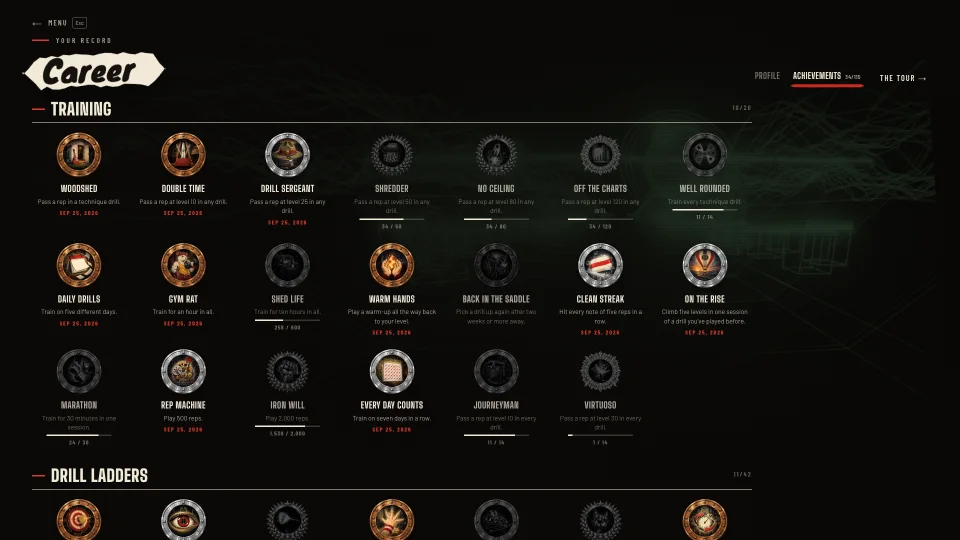
And there are badges to collect: three for each drill’s ladder (into its second stage, halfway up, and past its top) and twenty more for training itself, from your first rep to warming up after a break, five clean reps in a row, seven days in a row, 2,000 reps and level 30 in every drill.

  • 62 training badges, with names to match: Sure Shot, Dead Eye and Laser Guided for picking; Wobble, Shimmer and Heartstrings for vibrato.
  • A chart of your session at the end: every rep’s level and how it went.
  • On any screen. Training works on computers, tablets and phones, listening through a cable, an audio interface or the microphone.
Melodic’s badges: the Drill ladders page, three for each drill
Melodic’s badges for training

Questions

About the drills

Which drill should I start with?

If you’re new to guitar, Picking Accuracy, Finger Gym and Chord Changes are the foundations. Otherwise start with whatever you want to get better at: every drill finds your level by itself within a few reps. The Training screen also suggests one.

How long should I practise?

As long as you like. A rep takes five to ten seconds and everything is saved as you go, so five minutes on one drill is worth it. Short, regular sessions beat one long one, and a badge rewards seven days in a row.

Do the drills work with the Tour?

Yes. Almost every technique the Tour teaches has a drill (all but the two kinds of harmonics), and when one technique costs you a gig, the gig report offers its drill. See how each technique is played and the Tour.

Can I use the drills on bass?

The drills are written for six-string guitar in standard tuning. Bass players get their own parts in every song.

What if a level is too hard or too easy?

Just keep playing: the level moves after every rep. To jump there straight away, press − or + on the start card or while you play, and the drill remembers it.

Pick a drill. Your level is waiting.

14 technique drills that listen to your guitar and adapt after every rep · free in your browser

Start training free See how every technique is played