Comp
A compressor: evens out loud and soft picking, so notes ring on. Sustain, Attack and Blend, which mixes the squeezed sound with your guitar as it comes in, so the pick keeps its bite.
Plug in your guitar or bass and play it through Melodic’s amp: 10 amps with their speaker cabinets, five pedals and 20 preset tones, or a tone you dial in yourself and save. You hear every knob the moment you turn it, in the menus, in every song and in every drill. It’s free, and there’s nothing to install.
The whole rig
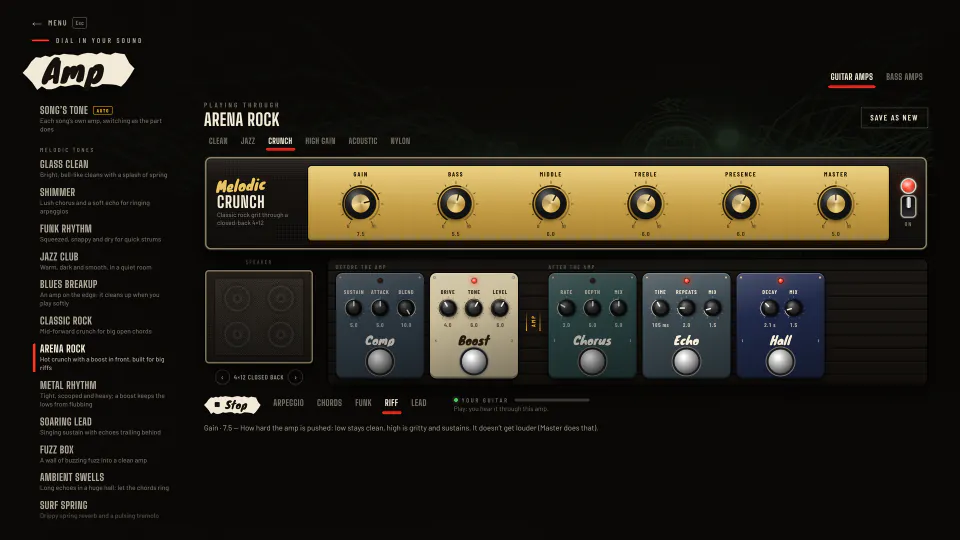
The Amp screen lays your sound out the way it runs: your tones down the side, the amp head and its knobs, the speaker cabinet, and the pedalboard in signal order. Pick a tone and you hear it straight away. Turn anything and the tone is yours to keep.
The amps
Every amp here is one that Melodic’s songs are played through, built the way a real amp is: tube gain stages, a tone stack, a power amp that sags when you dig in, and a speaker cabinet. With every knob at 5 and the pedals off, you hear exactly the song’s tone. Pick an amp to see its faceplate.










Clean: a glassy combo that stays clean until you dig in. Tones built on it: Glass Clean, Shimmer, Funk Rhythm, Blues Breakup, Fuzz Box, Ambient Swells and Surf Spring.
The knobs
Each amp has the controls you’d find on a real one, from 0 to 10. Drag a knob up or down (hold Shift for fine moves), scroll over it or use the arrow keys, and double-click to put it back to 5. Point at a knob and the amp tells you what it does.
The acoustic and nylon-string voicings have no Gain knob: they stay clean.
The pedals
The compressor and the drive pedal go in front of the amp, where a drive pedal pushes it into grit. Modulation, echo and reverb come after it, as if they were in the amp’s effects loop, so the repeats and the room stay clear however hard the amp is driven. Stomp a footswitch to turn a pedal on; the arrows on a pedal change its kind.

A compressor: evens out loud and soft picking, so notes ring on. Sustain, Attack and Blend, which mixes the squeezed sound with your guitar as it comes in, so the pick keeps its bite.
Boost, Overdrive or Fuzz, pushing the amp into grit. Drive, Tone and Level. It runs at four times the sample rate, which keeps even a full-on fuzz free of harsh digital aliasing.
Chorus, Flanger, Phaser or Tremolo. The chorus, flanger and phaser sweep left and right a quarter-turn apart, for a wide stereo sound. Rate, Depth and Mix.
A delay whose repeats bounce between left and right, darkening and softening like tape. Time, Repeats and Mix.
Spring, Plate or Hall: the room around your amp. Decay, in seconds, and Mix.
Preset tones
Melodic’s own tones cover the sounds songs ask for most: 14 for guitar and 6 for bass. Each plays a riff that suits it when you press Hear it, and each is only a starting point: turn a knob and it’s marked Edited, ready to save as yours.
| Tone | Amp and speaker | Pedals on | The sound |
|---|---|---|---|
| Guitar | |||
| Glass Clean | Clean · 2×12 open back | Compressor, Spring reverb | Bright, bell-like cleans with a splash of spring |
| Shimmer | Clean · 2×12 open back | Chorus, Echo, Plate reverb | Lush chorus and a soft echo for ringing arpeggios |
| Funk Rhythm | Clean · 2×12 open back | Compressor | Squeezed, snappy and dry for quick strums |
| Jazz Club | Jazz · 2×12 open back | Hall reverb | Warm, dark and smooth, in a quiet room |
| Blues Breakup | Clean · 2×12 open back | Overdrive, Spring reverb | An amp on the edge: it cleans up when you play softly |
| Classic Rock | Crunch · 4×12 closed back | Plate reverb | Mid-forward crunch for big open chords |
| Arena Rock | Crunch · 4×12 closed back | Boost, Echo, Hall reverb | Hot crunch with a boost in front, built for big riffs |
| Metal Rhythm | High Gain · 4×12 closed back | Overdrive | Tight, scooped and heavy; a boost keeps the lows from flubbing |
| Soaring Lead | High Gain · 4×12 closed back | Echo, Hall reverb | Singing sustain with echoes trailing behind |
| Fuzz Box | Clean · 2×12 open back | Fuzz, Spring reverb | A wall of buzzing fuzz into a clean amp |
| Ambient Swells | Clean · 2×12 open back | Compressor, Chorus, Echo, Hall reverb | Long echoes in a huge hall: let the chords ring |
| Surf Spring | Clean · 2×12 open back | Tremolo, Spring reverb | Drippy spring reverb and a pulsing tremolo |
| Acoustic | Acoustic · steel-string body | Compressor, Plate reverb | Your electric, as a steel-string acoustic |
| Classical | Nylon · nylon-string body | Hall reverb | Soft and woody, like a nylon-string |
| Bass | |||
| Round & Deep | Bass · 4×10 bass cabinet | Compressor | Warm, full lows that sit under the band |
| Punchy Pick | Pick Bass · 4×10 bass cabinet | Compressor | Defined mids for a picked rock bass |
| Growl | Pick Bass · 4×10 bass cabinet | Overdrive | Grind on top, solid lows underneath |
| Slap & Pop | Slap · 4×10 bass cabinet | Compressor | Scooped and snappy |
| Fretless Sing | Fretless · 4×10 bass cabinet | Chorus, Plate reverb | Smooth and vocal, with a little chorus |
| Deep Dub | Bass · 4×10 bass cabinet | — | All bottom, no bite |
The song’s tone
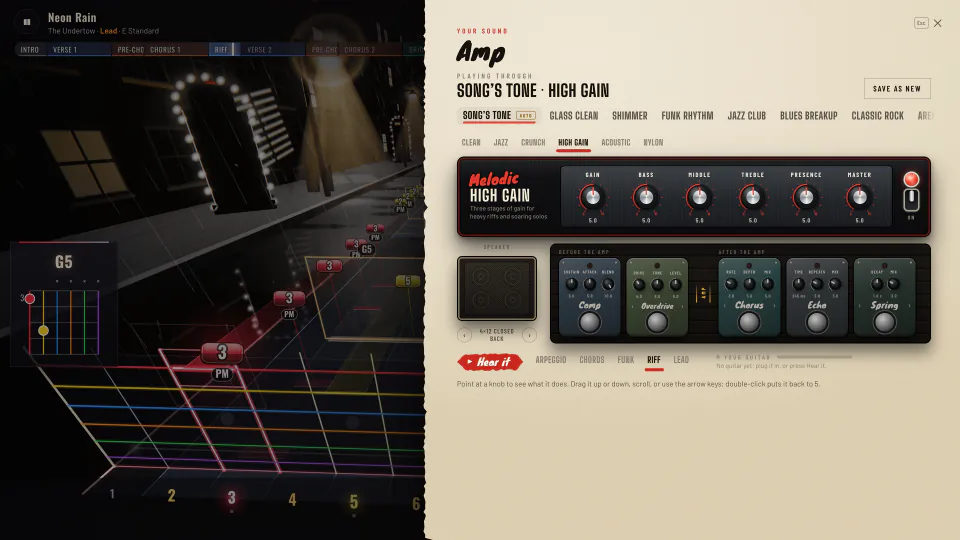
Until you pick a tone, the amp is set to Song’s tone. You play through each song’s own amp, clean for a ballad, crunch for a rock riff, high gain for a metal part, and it switches when the part does. The drills work the same way, each with its own tone.
Want your own sound in a song? Open the amp from the pause menu, or from the start card when you’re learning a song. It slides in over the song, and every change is heard straight away. Pick Song’s tone again to go back.
Your tones
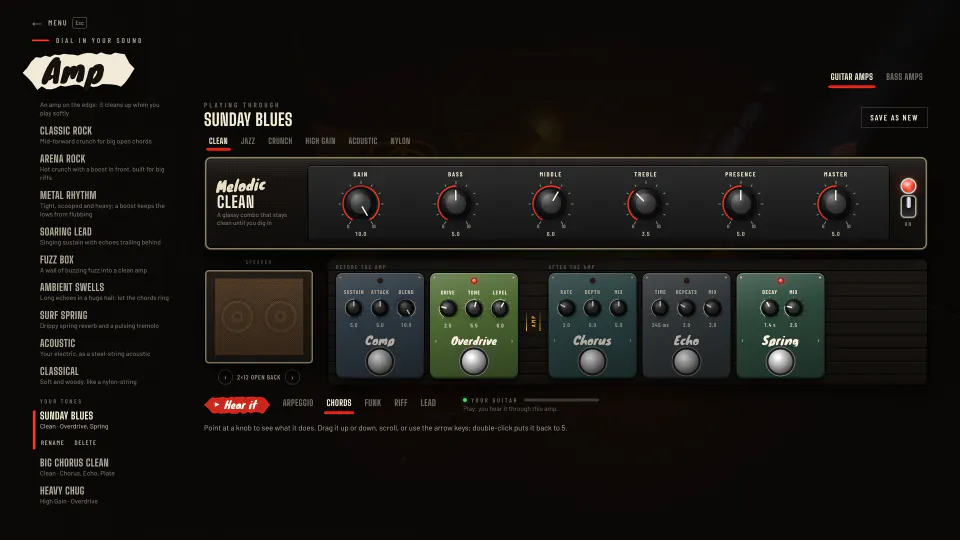
Found a sound you like? Save as new keeps it under Your tones, with any name you like. Pick it whenever you want it. Tweak it, then Save to keep the change or Undo changes to go back. Rename or delete it from the list. You can keep up to 60.
Bass amps
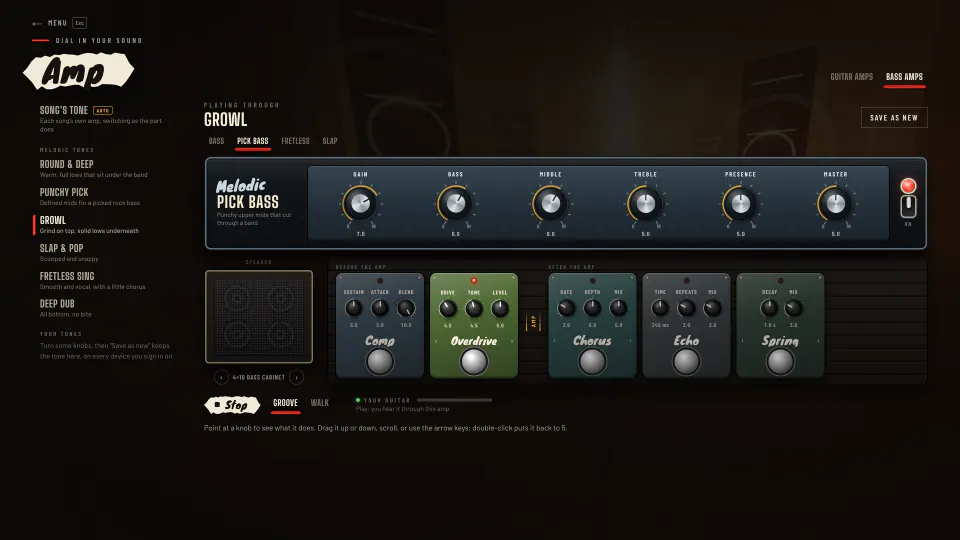
Bass players get amps of their own. Bass is round and deep, with the clean DI blended in. Pick Bass has punchy upper mids that cut through a band, Fretless a singing, vocal middle, and Slap is scooped and snappy for slap and pop. They play through a 4×10 bass cabinet (or a 4×12 or 2×12), with the same five pedals and 6 tones, from Round & Deep to Deep Dub.
Plug in
A USB audio interface or a guitar-to-USB cable gives you the best sound and the least delay. The first-time setup finds your input and sets your levels.
It’s in the main menu and in Settings → Your guitar. In a song it’s in the pause menu, and on the start card when you’re learning a song.
The song’s tone, one of Melodic’s or one of yours. No guitar to hand? Press Hear it.
Change the amp or the speaker, turn the knobs, stomp the pedals, then Save as new.
Switch Melodic’s amp off with its power switch (or in Settings → Your guitar) and your guitar plays exactly as it comes in, for your own amp, modeler or pedals in front of the interface. If your amp or interface already lets you hear your guitar, choose “I hear it already” in the setup’s Hear yourself step and Melodic won’t play it at all.
Good to know
An amp sim, short for amp simulator, is software that does what a guitar amp does: the preamp’s gain and tone controls, the power amp, and the speaker cabinet that shapes the sound, usually with effects pedals in front of it and behind it. You’ll also hear it called amp modeling or a virtual amp. A modeler usually means a hardware box that does the same job on a pedalboard.
Most amp sims are plugins for recording software. Melodic’s runs in your browser, so you can plug in and play through it with nothing to install, and it comes with a game that teaches you the songs to play through it.
Questions
Yes. The amp is part of Melodic, which plays free in your browser, and saving your own tones is free too.
No. Melodic runs in your browser on a computer, tablet or phone. On a computer you can also install it as an app if you like.
Yes. Open Amp from the main menu and your guitar plays through it for as long as you like.
About half a millisecond: nothing in it looks ahead. The delay you hear comes mostly from your audio interface, your browser and your headphones. An audio interface and wired headphones give the lowest delay, and the setup shows the delay your computer reports.
Yes. Switch Melodic’s amp off with its power switch, or in Settings → Your guitar, and your guitar plays as it comes in. If your amp or interface already lets you hear it, choose “I hear it already” in the setup.
Yes. There are four bass amps (Bass, Pick Bass, Fretless and Slap), a 4×10 bass cabinet, the same five pedals and six bass tones.
Yes. Hear it plays a riff on Melodic’s modelled guitar through the amp, and every knob you turn is heard as you turn it.
Yes, if you sign in: your saved tones go with your account. Without an account they stay on the device you made them on.
Melodic hears a microphone fine, but only plays it back once you tell it you’re on headphones, since your speakers would feed back into it. For the amp, a cable or an audio interface sounds best.
10 amps · five pedals · 20 preset tones and your own · free in your browser
Open Melodic Set up your guitar